

The Feast of San Gennaro is one of Manhattan’s most colorful ethnic festivals. At manhattanski.com, we explore why this event has remained a true hallmark of Little Italy for nearly a century.
What started as a small street event has grown into a massive 11-day celebration that still masterfully blends religious processions with the aroma of grilled sausages and powdered sugar-dusted zeppole. It is amazing how these ethnic traditions of the past have taken root so well amidst the skyscrapers.
When and Where the Feast of San Gennaro Takes Place
The Feast of San Gennaro unfolds every year in Manhattan’s Little Italy. The main artery is Mulberry Street between Canal Street and Houston Street, extending onto Hester Street and Grand Street. The streets are closed off, food stands, a stage, and amusement rides are set up, and for several days this slice of Manhattan turns into an open-air Neapolitan street fair.
In 2026, the festival is scheduled from September 17 to 27 — 11 days from Thursday to Sunday. This marks the 100th anniversary of the Feast of San Gennaro, which naturally means an even grander scale. Traditionally, the event kicks off around 11:30 AM and wraps up closer to 11:00 PM. The exact daily schedule of events is posted on the official website closer to the date.
The location was not chosen by chance. This is exactly where Neapolitan immigrants settled in the 1920s, and it was on Mulberry Street that they held their first block party in 1926. Since then, the location has remained virtually unchanged — except that the scale has grown from a single day and one block to eleven days and multiple blocks.
What This Event Is and Its History
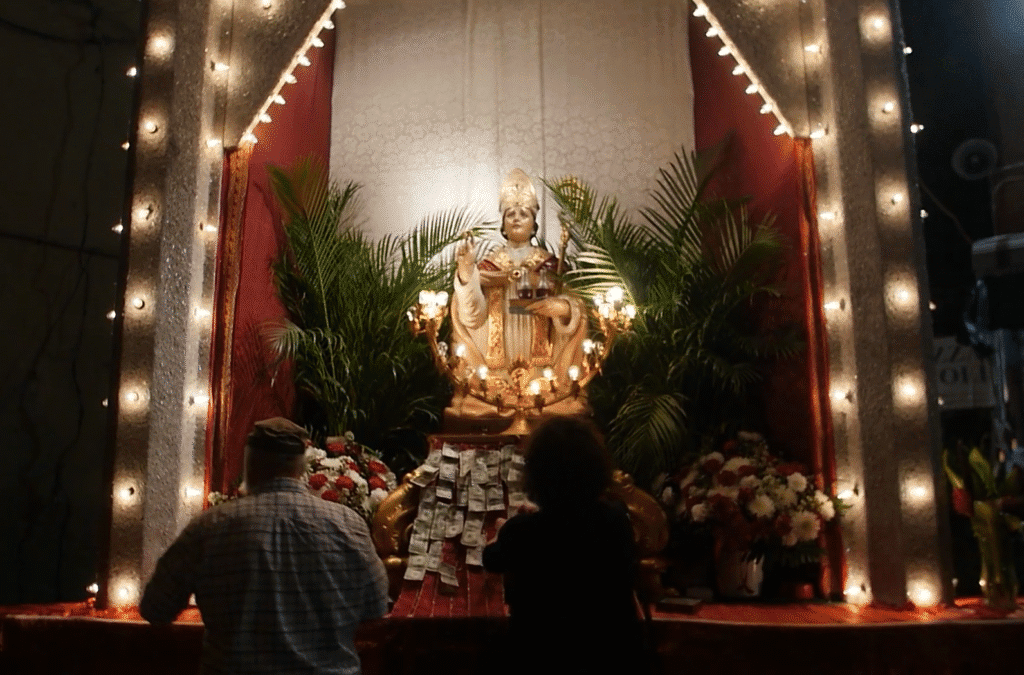
The feast is named in honor of Saint Januarius (San Gennaro), the Bishop of Benevento, who was martyred in 305 AD during the reign of Emperor Diocletian. In Naples, he is considered the primary protector against fires, earthquakes, plagues, droughts, and the eruptions of Mount Vesuvius. It is believed that the saint’s blood, collected after his execution, turns from solid to liquid twice a year. According to legend, this happens in May and on September 19, the day of his martyrdom. This very day became the centerpiece of the annual commemoration.
In Manhattan, the event has a special scale and flavor. Neapolitan immigrants brought the tradition here to preserve their connection with their ancestors, culture, and the customs of their homeland. The organizers note on the festival’s official website that the feast honors the memory of their ancestors and reflects the culture and traditions of those who settled in Little Italy.
What to Expect: Food, Entertainment, and Traditions
At the Feast of San Gennaro, street food is the main character. The classic sausage and pepper sandwich has held the top spot for decades, closely followed by zeppole — those deep-fried dough balls heavily dusted with powdered sugar. Next in line are arancini, cannoli, deep-fried Oreos, and anything else you can quickly eat with your hands without leaving the crowd.
Locals joke that after a few of these servings, their shirts won’t button up anymore, but no one seems to mind. To burn off at least some calories after such a feast, many head for a walk around the island — for example, to Hudson River Park, where you can see how Manhattan’s coastal areas are protected.
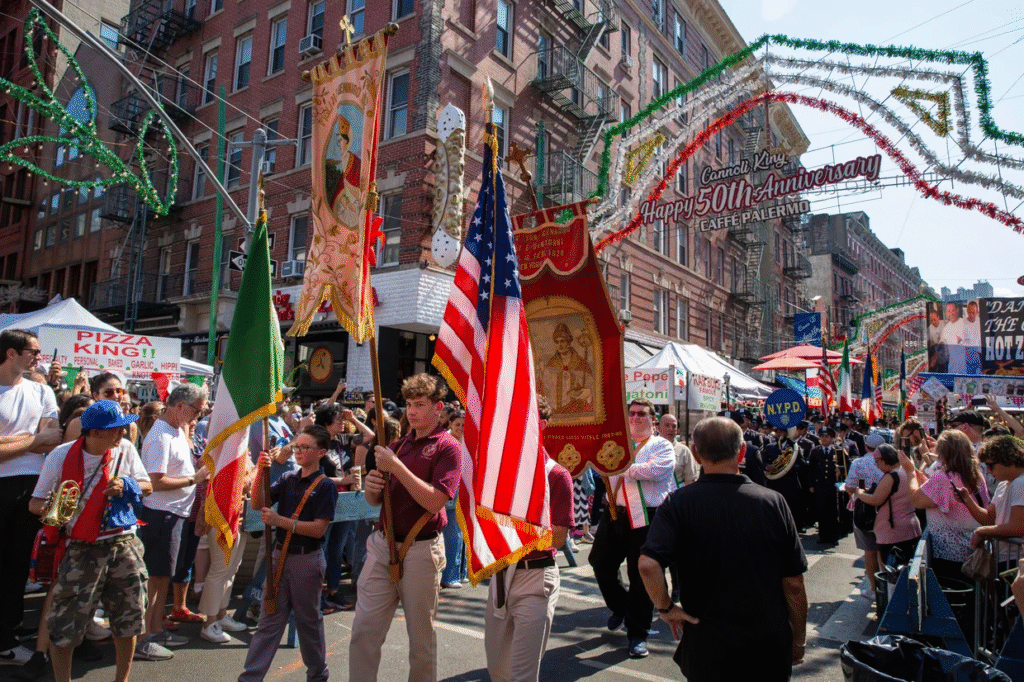
Entertainment also plays a major role. Live music plays almost continuously, ranging from Italian crooners to live bands and karaoke. Occasionally, there are cannoli or meatball eating contests, where the contestants look simultaneously ridiculous and heroic. The climax is the grand procession featuring the statue of the saint, marching bands, floats, and local celebrities as guests of honor.
The traditional part is held slightly apart, yet close by. The blessing of the vendor stands and a solemn mass at the Church of the Most Precious Blood peacefully coexist with carnival rides and the smell of fried food. All this together creates a strange but very New York mix: a 4th-century religious ritual and a modern street fair where everyone can find their own corner.
Practical Tips for Guests and FAQs
What do you want to know about the Little Italy festival? What tips should you keep in mind?
How to Get There?
For those planning a trip, keep in mind: it gets especially crowded on weekends and in the evenings. The Spring Street or Canal Street subway stations (lines 6, N, Q, R, J, Z) will drop you off right near the epicenter. It is best not to try driving — parking in the area becomes a real quest.
How Much Time to Allocate?
Two to three hours will be enough for everything. If you want to eat and stroll in peace, come on a weekday afternoon. On weekends and after 6:00 PM, it gets crowded and noisy, though for some, this has its own appeal.
What to Bring?
- Cash — many stands still prefer paper bills.
- Comfortable shoes, because you will have to walk a lot.
- And an empty stomach — otherwise, you won’t have time to try everything.
Should You Bring Kids?
Yes, if they love carnival games and sweets. The only thing is to hold their hand — otherwise, the little ones can easily get lost. Italians are very emotional, and when the crowd is large, a moment of inattention can sometimes lead to unnecessary stress.
Obviously, Italians in New York deeply love their culture and do not want to lose touch with it. And from time to time at the festival, you can catch notes of nostalgia, somewhat similar to what is heard in the song “Ferry Cross the Mersey” dedicated to Liverpool.