

Unfortunately, in the chronicles of Manhattan (one of the five boroughs of New York), there are infamous stories about some streets or distinct neighborhoods. Five Points is one of such districts. In the chronicles, Five Points will remain as a quarter of thieves and robbers who ruled on this territory. Find out more at manhattanski.
The Five Points neighborhood is located near the modern Columbus Park, between the Manhattan Civic Center and Chinatown. The Five Points district got its name from the intersection of three city streets: Orange Street, Anthony Street and Cross Street. This convergence formed five different angles, hence the name “Five Points”. In today’s context, the closest intersection to historic Five Points is at the crossroads of Columbus Park with Worth Street and Mulberry Street.
Five Points: how did it all begin?
Five Points’ notoriety is traced before it became a neighborhood. The area originally covered a body of water known as Collect Pond, which served as a vital source of water for Сolonial New York. However, with the passage of time and the unfolding of the Revolutionary War in the country, the pond became polluted and unfit for use. The polluted waters were eventually drained into the Hudson River by a canal that later became Canal Street. By 1812, the once beautiful and useful pond was filled in without any special financial costs for this type of work.
The residential buildings constructed on the site of the former lake (mainly made of brick and wood) turned out to be structurally unstable. This led to subsidence and tilting of the buildings. As a result, this area began to attract people who could not find another place to live. Most commonly, these were people with limited financial opportunities and those who only profited from the strata of the population who earned money through hard work.
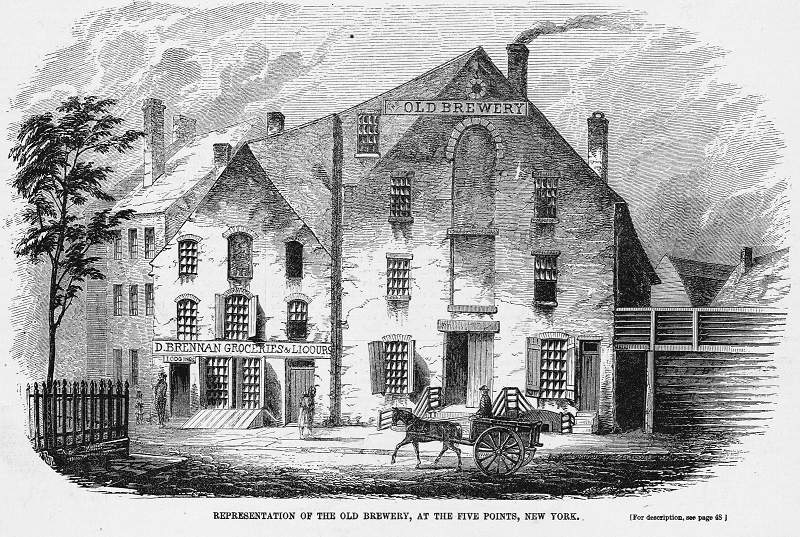
The heart of the growing Five Points neighborhood was a brewery established in 1792 on Cross Street known as Coulthard’s Brewery, later known as the Old Brewery. This facility became infamous due to the numerous terrible crimes that took place within its walls. As expected, gangs such as the Ugly Forks (named after the fork hats), the Dead Rabbits and the Bowery Boys appeared and united for mutual protection.
How bad was it in Five Points in reality?
In 1952, Kenneth Dunshee vividly described the conditions and atmosphere of life in Five Points in his work “As You Pass By”, dedicated to the history of volunteer fire departments that preceded the New York City Fire Department. Dunshee’s story gives a considerable insight into the derelict state of that same Old Brewery, or the five-story building that has fallen into disrepair.
Near one of its walls, an alley led to a large room where more than 75 people of different nationalities and races coexisted. This place was known as the “Den of Thieves”, which fully corresponds to its reputation. Along the opposite wall stretched another wretched alley, which was called Murderers’ Alley and was even worse than its “fellow brother”. The name alone gives an insight about what exactly might have been going on next to these places in the Old Brewery.
Upstairs, in more than 75 cells, there was a staggering number of people – more than 1,000 people, including men, women and children. The area resembled a maze of underground passages and treacherous dead ends, where the police officers only dared to enter in large groups, since on average one murder occurred in the Old Brewery every night for 15 years!
Description of the infamous district in the works by famous writers
Five Points was considered to be too violent, lawless and unreliable even in the New York of a century ago. The Old Brewery was eventually torn down, and the gangs were eliminated. In the years of the story (that is, in 1952, when Kenneth Dunshee was developing his historical work), the district bore little resemblance to the wild, chaotic, and lawless place it had been in 1850. In addition to that, Charles Dickens described Five Points in his 1842 travelogue “American Notes for General Circulation”, which contributed to the collective understanding of the area during that era.
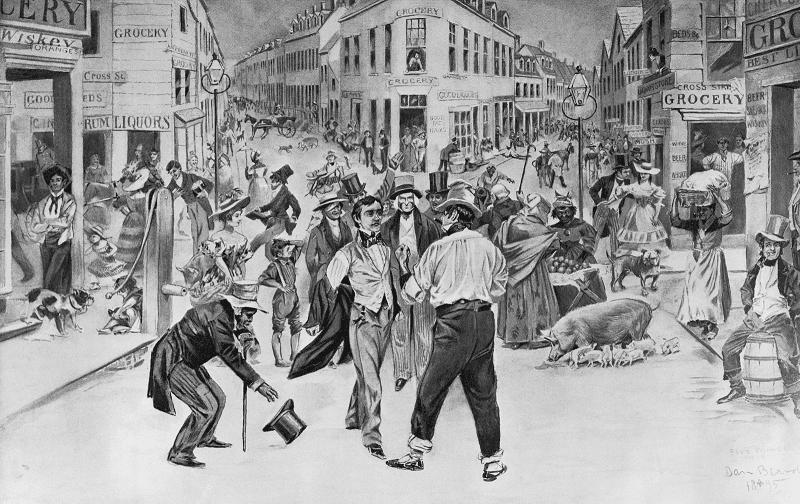
In the work by Charles Dickens “American Notes for General Circulation” of 1842, he vividly depicts the neglect of the Five Points district. Dickens describes this area in detail, expressing his horror when he dares to walk through its wretched streets. For example, he draws attention to the presence of a square filled with dilapidated houses, some of which can only be reached by rickety wooden stairs. Curiosity drives him to explore further, delving into the very heart of Five Points. He watches the narrow alleyways that branch out in different directions, emitting an all-pervading stench of dirt and filth.
Life in this wretched place ends as sadly as in any other disadvantaged neighborhood. The faces peeking out from the doorways display rudeness and arrogance that can be found in any corner of the world. The debauchery that permeates this district has prematurely aged the buildings themselves in which some Manhattan citizens still live. Dickens draws attention to rotten beams being on the verge of collapse, patched and broken windows, which dimly reflect the atmosphere of that time in the quarter.
Among these dwellings, many residents lead a life that resembles the life of “pigs”. Dickens asks whether they wonder why their masters walk upright instead of crawling on all fours, or why they communicate with a help of speech instead of grunting. Thanks to Dickens’ expressive narration, it is possible to be transferred to the Five Points of that time, a place of despair and degradation, where the consequences of life are immersed in vices and poverty.
Remnants of Five Points
In the 1920s, physical traces of the old Five Points began to disappear. Courthouses and parks replaced the major part of the former landscape of the district. By the 1960s, the remnants of the wooden and brick buildings were demolished to free up space for high-rise apartment buildings. However, for intrepid explorers, fragments of the remnants of Five Points can still be discovered.
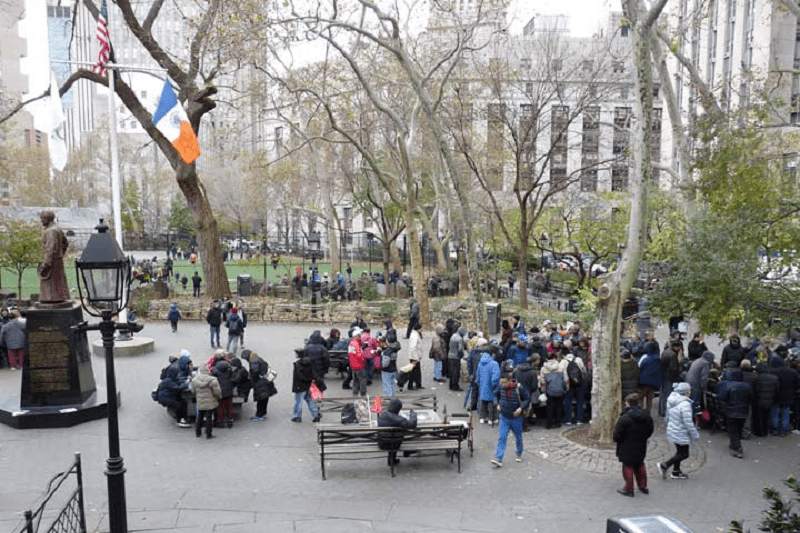
One of the most visible remnants is Columbus Park, founded in 1887 in the very heart of the former Five Points. This sprawling park took the place of some of the old houses that once occupied this area. Its design was entrusted to Calvert Vaux, the co-creator of Central Park and Prospect Park, which ensured its aesthetic perfection. Throughout its history, the park underwent various name changes. However, in 1911 it was officially named Columbus Park in recognition of the growing Italian community that settled in the vicinity.
Although many things have changed and evolved over time, Columbus Park is a testament to the legacy and ever-changing nature of the once infamous Five Points. A walk through its territory allows you to glimpse into the inevitable historical significance of this iconic district.
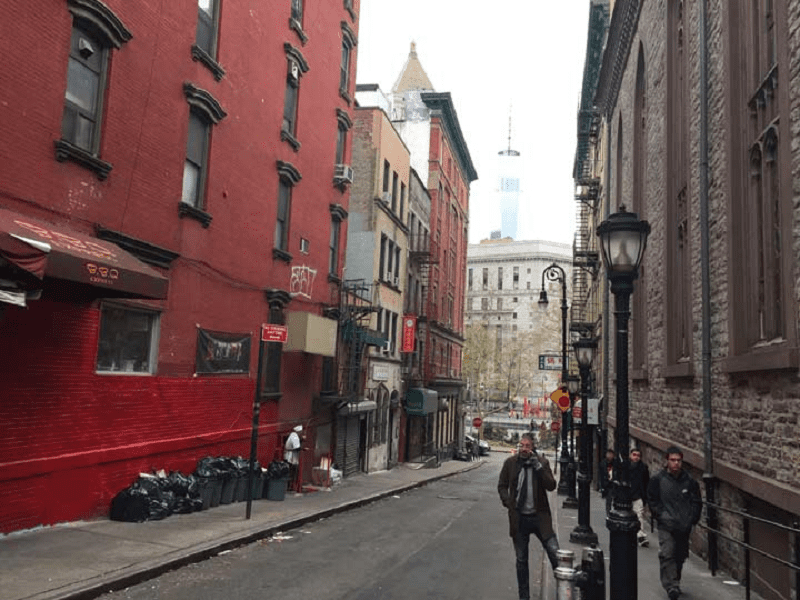
Mosco Street, formerly known as Park Street and even earlier as Cross Street, ran through the heart of the Five Points neighborhood. In the mid-1800s, Park Street covered in total five blocks, stretching from Center Street and Duane Street to northeast to Mott Street. Only the easternmost block of Park Street remained intact. The remaining sections of the street were replaced by the Civic Center courthouses, which may be familiar to viewers of the popular TV series such as “Law and Order” and “Police Square”.